

Environmental Humanities Research Group
Environmental Humanities Members
-
-
Dr. Brandy Thomas Wells, History
-
Kamala Shrestha, Sociology
-
Dr. Graig Uhlin, English
-
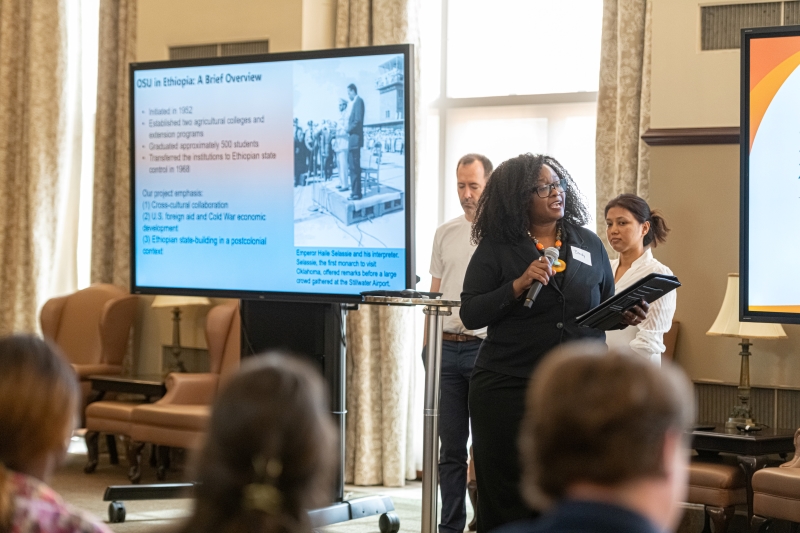
OSU's Agricultural Extension in Ethiopia: Cultivating Global Citizenship and Connections
Abstract:
This project explores Oklahoma State University’s (OSU) global land-grant mission
through an in-depth study of its involvement in the Ethiopian Point Four Program from
the 1950s to 1968. By examining this early Cold War-era international extension initiative,
the project seeks to illuminate the intersections of U.S. foreign development policy,
postcolonial state-building in Ethiopia, and OSU’s institutional evolution as a globally
engaged university. The primary outcome will be a public-facing digital humanities
website that recovers Ethiopian perspectives, highlights the cultural and educational
dimensions of U.S.-Ethiopian exchange, and traces the long-term impacts of the partnership.
Employing archival analysis, oral histories, and a wide range of U.S. and Ethiopian
sources, the research investigates how American and Oklahoman land-grant ideals were
enacted abroad, how cross-cultural exchanges shaped the identities of participants
and institutions on both sides, and how the legacy of this initiative persists today.
Ultimately, the project offers timely reflection on historical models of global engagement
during a moment of renewed debate over the future of international development and
American foreign assistance and engagement.
Description:
In May 1952, Oklahoma Agricultural and Mechanical College (now Oklahoma State University) signed an agreement to establish and assist in the operation of an agricultural college in Ethiopia modeled after U.S. land-grant institutions. This initiative was part of the U.S. State Department’s Point Four Program, started in 1949 to provide financial and technical assistance to developing nations. The agreement resulted in the founding of two institutions: the Jimma Agricultural Technical School, a preparatory school, and the Imperial Ethiopian College of Agriculture (Haramaya University), which opened in 1957 near Haramaya. Many OSU faculty relocated to Ethiopia to help establish and develop these schools before their administration was turned over to local control. These initiatives in international agricultural extension fostered collaboration and cultural exchange: Emperor Haile Selassie visited the OSU campus in 1954, and Ethiopian students enrolled in graduate programs and created social organizations at OSU following these outreach efforts.
Our project revisits and analyzes this history from a contemporary perspective. The recent drawdown in USAID and other global aid programs suggests a possible reordering of the U.S.’s global presence in terms of economic development and humanitarian aid, making these histories of postwar international collaboration newly relevant.
We are also approaching the 75" anniversary (in 2027) of the signing of the agreement
under the Point Four program. Our project will engage with the archival holdings related
to OSU’s outreach in Ethiopia held at the Edmon Low Library, and we aim to understand
these efforts in the context of other historical and ongoing forms of international
agricultural extension.
Distinct from narrating this history as one of economic development and nation-building,
our interest in particular lies with the social and cross-cultural aspects of this
sustained collaboration— that is, with the ordinary or quotidian dimensions of OSU’s
presence in Ethiopia and with theexperiences of Ethiopians who attended OSU. As we
examine the archive, therefore, we are concerned with looking for stories and voices
that have not been or only partially preserved.